Nearly 300 educators from across the state and as far away as Wisconsin attended the Hmong History and Cultural Studies Model Curriculum Conference from March 27 through 28.
Hosted in Sacramento, home to one of the largest Hmong communities in California, the two-day event brought together educators, scholars, community members, students, and culture bearers. These groups provided guidance and tools to support the implementation of the Hmong History and Cultural Studies Model Curriculum (HHCSMC) in their schools, districts, and communities.
“I hope the people listening were inspired, not just by me, but by the other panelists, and hopefully use this to teach others or apply it to themselves,” said Hannah Chek, a student panelist from Stockton Unified School District.
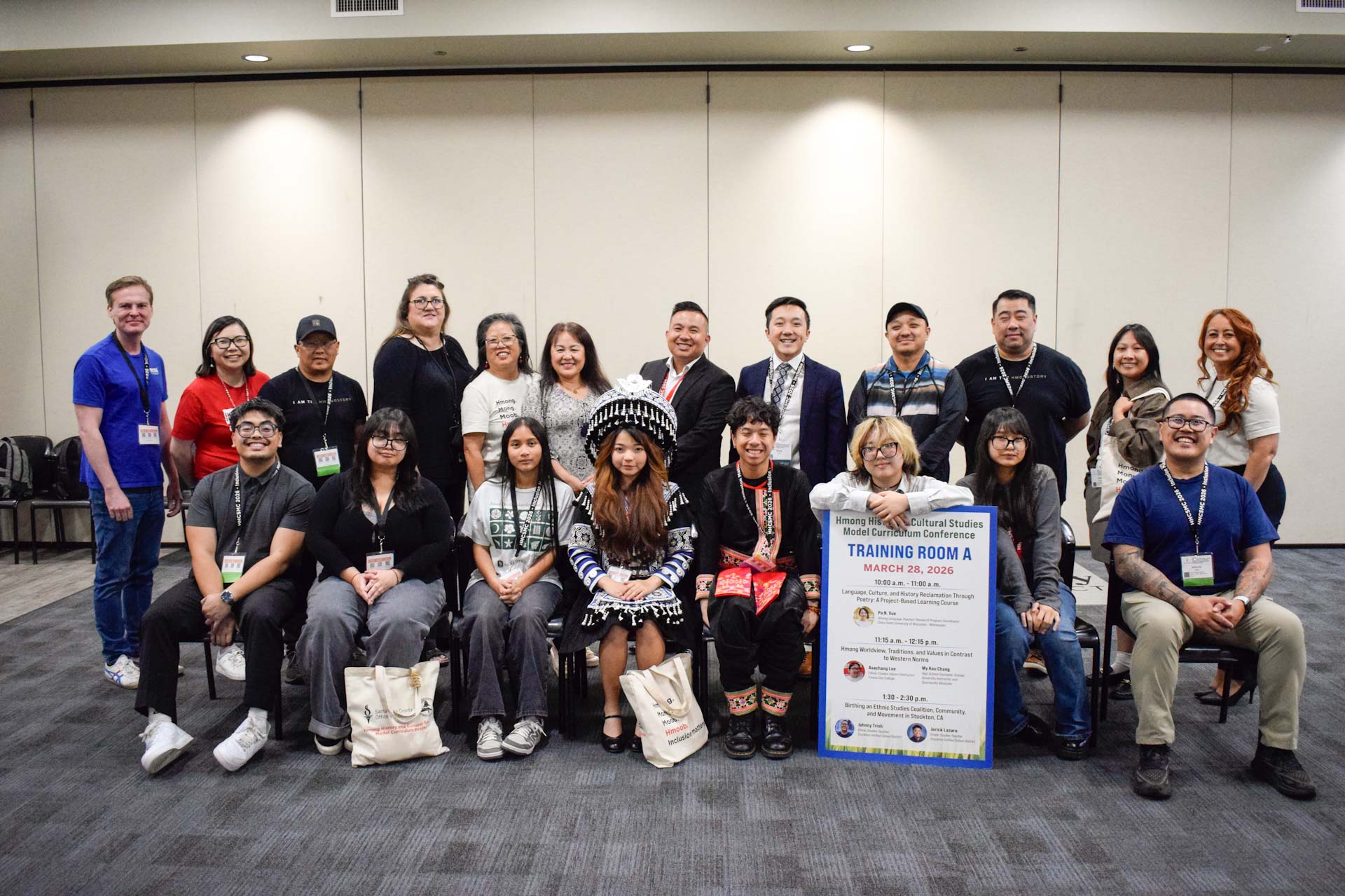 Group of Conference Presenters and Event Staff
This was the final conference in the series of ten Southeast Asian Model Curriculum events, which focused on student voice and uplifted Hmong youth through storytelling, cultural celebration, and educator collaboration.
“We intentionally centered this last conference around the students to reground us in our why,” said Kristina Ravo, Coordinator of History-Social Science and Civic Engagement at the Santa Clara County Office of Education (SCCOE). “We did this by having learning walks at the elementary and secondary levels, student panelists and presenters in at least a quarter of our sessions, student artwork on display, and student performers to start and end our day on Saturday.”
In addition to viewing Hmong student performances, such as dance, song, and martial arts, attendees participated in cultural experiences like HMoob Cultural Wealth Through Indigo Processing. This hands-on activity provided attendees with the opportunity to create their own mini-resist art piece, which was dyed in an indigo vat.

“Aligning with the goals of AB 101 and AB 167, this gathering highlighted the power of education in fostering understanding, inclusivity, and representation,” said Ravo.
Assembly Bill 101 established the development of a statewide model ethnic studies curriculum for high school students and allowed school districts to offer ethnic studies as an elective social science course.
Assembly Bill 167 specifically calls for the inclusion of authentic voices and perspectives in the model curriculum. This legislation led to the development of the HHCSMC, which highlights the histories, cultures, identities, and civic contributions of Hmong communities in the United States.
“The work we’ve done here not only amplifies the voices and histories of Hmong Americans but also ensures a more equitable future for all students,” said Ravo.
Notable presenters included:
- Caroline Thao, Social Science and Hmong Language Educator at Twin Rivers Unified School District
- Neng Thao, documentarian, linguist, and community organizer
- Dr. Chia Youyee Vang, Professor of History at the University of Wisconsin-Milwaukee
- Mai Vang, Sacramento City Council Member for District 8
- Dr. Pa N. Vue, Hmong Language Teacher and Research Program Coordinator at the University of Wisconsin-Whitewater
- Johnnie Yang, PhD candidate from UCLA
- student panelists from Twin Rivers and Stockton Unified School District.
The HHCSMC curriculum represents the Hmong people from Laos, Thailand, Vietnam, and China, encompasses the history of their migration to the United States, and showcases cultural beliefs and traditions.
Developed by the Orange County Department of Education (OCDE), the curriculum is one of three projects (Cambodian, Hmong, and Vietnamese American experiences) in response to legislation supporting culturally inclusive instruction.
All three curriculum features ready-to-use lesson plans, primary source documents, instructional essays, professional development activities, and other guidance materials for K-12 classrooms.